
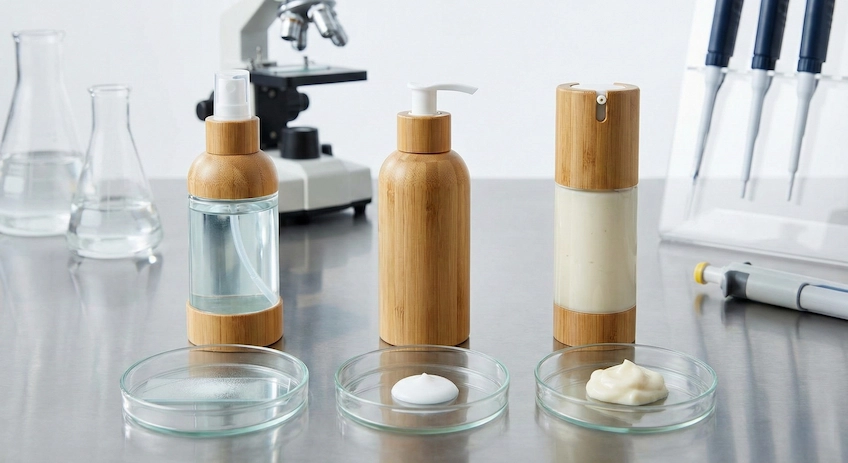
For cosmetic brands, the "dispensing experience" is the final hurdle in user satisfaction. A pump that clogs with thick cream or squirts watery toner too aggressively can ruin a premium product. The secret lies in matching the Dispenser Mechanism to the Product Viscosity.
From water-thin essences to heavy body butters, every formula requires a specific pump engine. At ECO-BAMBOO, we help brands engineer the perfect pour. Here is the technical guide to selecting the right dispenser for your viscosity.
1. Understanding Viscosity: The "Flow" Factor
Viscosity is the measure of a fluid's resistance to flow. It dictates the pump's spring strength and dip tube diameter.
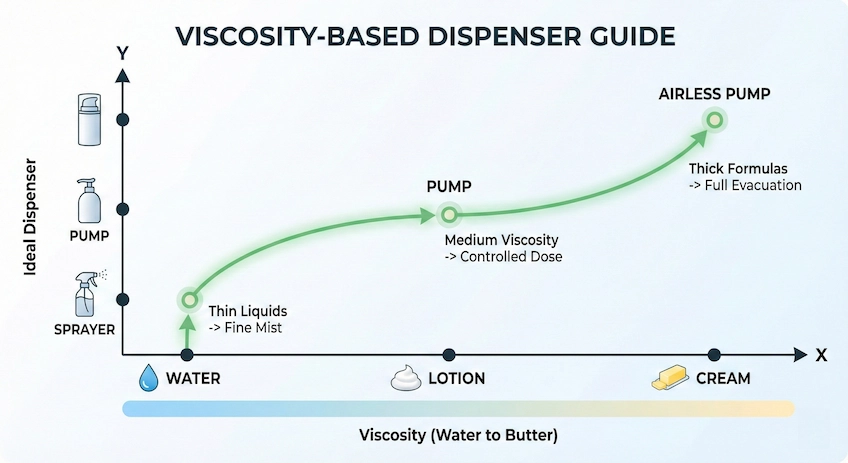
- Low Viscosity (Water-like): Toners, micellar water, essential oils.
- Challenge: Leaking, uncontrollable splashing.
- Solution: Fine Mist Sprayers or Treatment Pumps with small orifices (0.15cc - 0.2cc output).
- Medium Viscosity (Honey-like): Face lotions, serums, liquid soaps.
- Challenge: Standard flow.
- Solution: Standard Lotion Pumps (1.0cc - 2.0cc output). This is the industry workhorse.
- High Viscosity (Peanut Butter-like): Body butters, clay masks, sunscreens.
- Challenge: Cavitation (air pockets), pump failure.
- Solution: High-Viscosity Pumps with wider dip tubes or Airless Systems1.
2. The Airless Advantage for High Viscosity
For thick creams (>50,000 cps), gravity-fed pumps often fail because the product clings to the sides and won't flow down to the dip tube. Airless Pump Bottles2 solve this.
- Mechanism: A piston pushes the product up from the bottom.
- Benefit: No dip tube to clog. Handles creams that are too thick to pour. ensuring 99% evacuation.
3. Output Size (Dosage): Controlling the Experience
The "Output" is how much product comes out in one full press.
- 0.2cc - 0.5cc: Ideal for high-value face serums (Retinol, Vitamin C). Prevents waste.
- 1.0cc - 2.0cc: Standard for hand soaps and face washes.
- 3.5cc - 5.0cc: Required for body lotions and shampoos where users need a large amount quickly.
B2B Insight: Choosing the wrong output frustrates users. Imagine pumping 10 times to get enough body lotion!
4. Selection Matrix: Pump Features by Application
Use this table to specify the right pump for your product line.
| Viscosity Range | Product Example | Recommended Dispenser | Output |
|---|---|---|---|
| Very Low | Toner / Mist | Fine Mist Sprayer | 0.15cc |
| Low | Serum / Oil | Treatment Pump | 0.25cc |
| Medium | Face Cream | Standard Bamboo Pump3 | 1.0cc |
| High | Body Butter | Airless Pump1 | 1.5cc |
| Very High | Scrub / Clay | Wide-Mouth Jar | N/A |
5. Material Compatibility: The Hidden Factor
Viscosity isn't the only factor; chemistry matters. Aggressive ingredients (like Salicylic Acid or certain Essential Oils) can swell rubber gaskets in standard pumps, causing them to stick.
- Our Solution: ECO-BAMBOO offers pumps with Nitrile or Silicone gaskets and PP (Polypropylene) housings, which offer broad chemical resistance compared to standard PE components.
Conclusion
The "perfect" bottle is useless without the "perfect" pump. By aligning Viscosity, Output, and Mechanism, you ensure your customer experiences your product exactly as intended.
Whether you need a fine mist for a toner or a high-torque pump for a thick cream, ECO-BAMBOO has the engineered solution.
⚙️ Engineer Your Dispensing
Don't guess on performance. Request a technical sample kit to test your formula's viscosity with our pumps. 👉 Get Your Viscosity Test Kit