
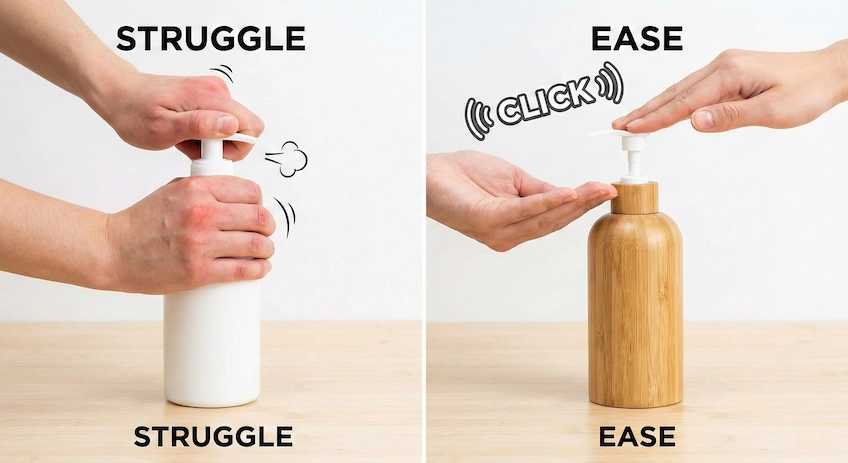
For a cosmetic brand, a pump that won't open is a disaster. It leads to frustrated customers, damaged product reviews, and unnecessary returns. Often, the pump isn't broken; the user simply doesn't understand the Locking Mechanism.
As a packaging manufacturer, ECO-BAMBOO designs pumps with intuitive open/close systems. However, different mechanisms require different "unlocking" techniques. Here is the definitive guide to troubleshooting stuck pumps for your customer support team.
1. Diagnose the Mechanism Type
Before forcing it, identify the lock style. Most modern pumps fall into three categories:
| Mechanism Type | Visual Cue | Common Application |
|---|---|---|
| Screw-Down Lock | Pump head sits flush with the collar. | Hand Soaps, Shampoos |
| Left-Right Clip | Pump head is raised; nozzle rotates 90°. | Bamboo Lotion Bottles1 |
| Airless (Vacuum) | No visible spring; small hole in base. | Bamboo Airless Bottles2 |
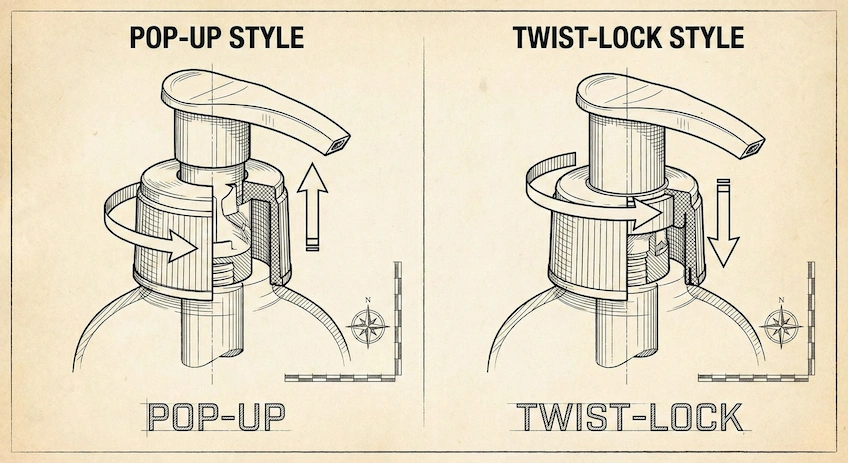
2. Technique A: The "Push-and-Twist" (For Screw-Down Pumps)
This is the most confusing mechanism for consumers because the pump spins freely without opening.
The Fix:
- Tighten the Base: Screw the collar (the part touching the bottle) tightly clockwise onto the bottle. If the base spins, the head won't pop.
- Push Down: Press the pump head flat against the bottle.
- Twist Counter-Clockwise: While holding the pump down, turn it to the left (Open). It should "pop" up.
B2B Tip: We recommend using Precision-Threaded Bamboo Collars3 to ensure the base grips the bottle neck securely, preventing the "spinning base" issue.
3. Technique B: The "Alignment Check" (For Clip Locks)
Luxury lotion bottles often use a cleaner "Left-Right" lock that doesn't pop up. The Fix:
- Look for a small notch or arrow on the collar.
- Align the nozzle with the notch to dispense.
- Turn the nozzle 90 degrees away to lock for travel.
4. Technique C: The "Airless Prime" (For Vacuum Bottles)
If the pump is open but nothing comes out, it's likely an Airless Bottle2 that needs priming. Airless bottles don't have a dip tube; they rely on a vacuum piston.
The Fix:
- Do Not Open: Never unscrew the cap, as this breaks the vacuum.
- The "Paperclip Trick": Find the tiny hole at the bottom of the bottle. Push a straightened paperclip gently into it to nudge the piston up.
- Pump Rapidly: Pump 10-20 times to re-establish the vacuum.
5. Manufacturing Quality: Why Pumps Get Stuck
Sometimes, it is a defect.
- Burrs: Extra plastic from molding can jam the thread.
- Overtightening: Factory machines may torque the pump so tight the plastic threads warp.
At ECO-BAMBOO, we perform Automated Torque Testing on every batch to ensure our pumps are tight enough to not leak, but loose enough for a customer to unlock easily.
Conclusion
A "stuck" pump is often just a misunderstood mechanism. By providing clear instructions (like "Tighten Base, Then Twist") on your packaging, you can solve 90% of these issues.
For a hassle-free experience, choose ECO-BAMBOO's user-friendly dispensing systems.
🔓 Smooth Dispensing Guaranteed
Stop customer complaints. Request a sample kit of our reliable, easy-open bamboo pumps. 👉 Get Your Quality Assurance Sample Kit