

The beauty industry produces 120 billion units of packaging annually, much of which ends up in landfills. For modern skincare brands, "Eco-Friendly" is no longer a niche; it is a baseline expectation. Consumers are demanding transparency, and regulators are tightening rules on plastic waste.
So, how do you make your packaging truly sustainable without sacrificing luxury or performance? At ECO-BAMBOO, we guide brands through the 3-Step Sustainability Transformation: Material Innovation, Refillable Design, and Lifecycle Management.
1. Material Innovation: Beyond Virgin Plastic
The first step is to reduce reliance on fossil fuel-based plastics.
- Bamboo (The Renewable Star): Bamboo is the fastest-growing plant on Earth. Our Bamboo Cosmetic Jars1 use FSC-certified bamboo shells, reducing plastic usage by up to 70% compared to solid plastic jars.
- PCR (Post-Consumer Recycled): Give waste a second life. Our Bamboo Lotion Bottles with PCR Inner2 combine a recycled plastic core with a premium bamboo outer, lowering the carbon footprint significantly.
- Glass: Infinitely recyclable. Pairing glass with a Bamboo Lid3 creates a plastic-free aesthetic that consumers love.
2. The Refill Revolution: Design for Reuse
The most sustainable package is the one you don't throw away. Refillable Systems build brand loyalty and drastically reduce waste.
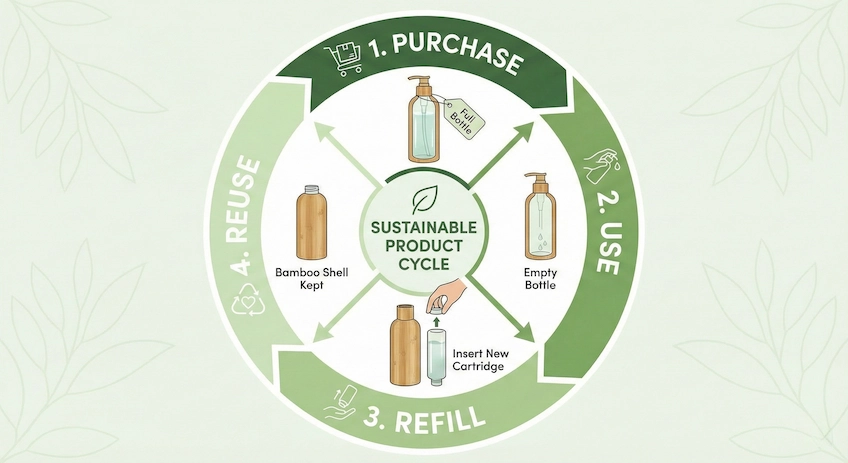
- How It Works: The consumer keeps the heavy, expensive outer shell (Bamboo/Glass) and only purchases a lightweight refill cartridge.
- Our Solution: Refillable Bamboo Airless Bottles4. The inner PP cartridge can be replaced, extending the life of the bamboo shell for years.
- Impact: Reduces shipping weight and packaging waste by over 80%.
3. Design for Disassembly: The Recycling Key
Mixed materials are a recycling nightmare. A pump with a metal spring inside a plastic head is often rejected by sorters.
- The Problem: Brands glue components together, making separation impossible.
- The Fix: We engineer Separable Components. Our bamboo collars screw off easily from the glass or plastic inner bottle, allowing the consumer to recycle the inner part and compost or reuse the bamboo shell.
- Mono-Material: We are developing all-PP pumps that remove the metal spring, making the entire dispenser recyclable in one stream.
4. Sustainability Matrix: Choosing Your Path
Where is your brand on the eco-journey?
| Level | Strategy | Packaging Choice | Impact |
|---|---|---|---|
| Level 1 (Good) | Material Swap | Bamboo-Clad PET Bottle2 | Reduces virgin plastic by 50%. |
| Level 2 (Better) | PCR Integration | PCR Inner + Bamboo Shell | Uses recycled waste; lower carbon. |
| Level 3 (Best) | Circular System | Refillable Airless4 | Reduces waste by 80%+; high loyalty. |
5. Supply Chain Transparency: The Hidden Footprint
Sustainability isn't just about the bottle; it's about how it got there.
- Local Sourcing: We source bamboo near our manufacturing facility to minimize transport emissions.
- FSC Certification: Ensures that your packaging supports responsible forest management, a key selling point for eco-conscious consumers.
Conclusion
How can skincare packaging be made more sustainable? Stop viewing packaging as trash. Start viewing it as a durable asset.
By switching to Refillable Bamboo Systems and PCR Materials, you not only save the planet but also position your brand as a leader in the Clean Beauty revolution.
🌿 Start Your Eco-Transformation
Ready to reduce your plastic footprint? Request a sample kit of our Refillable and PCR Bamboo packaging solutions. 👉 Get Your Sustainable Sample Kit
