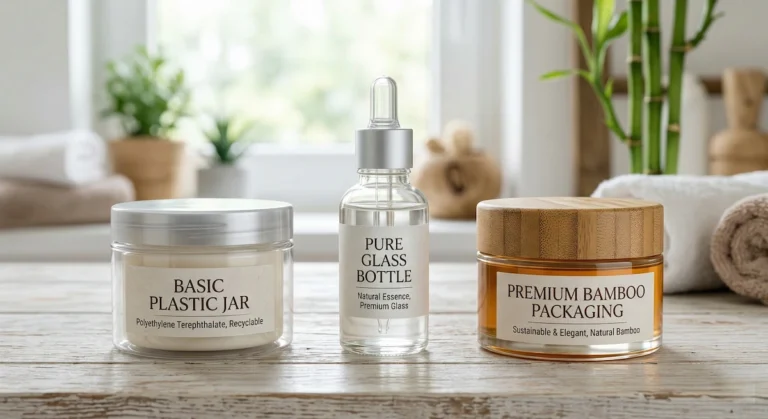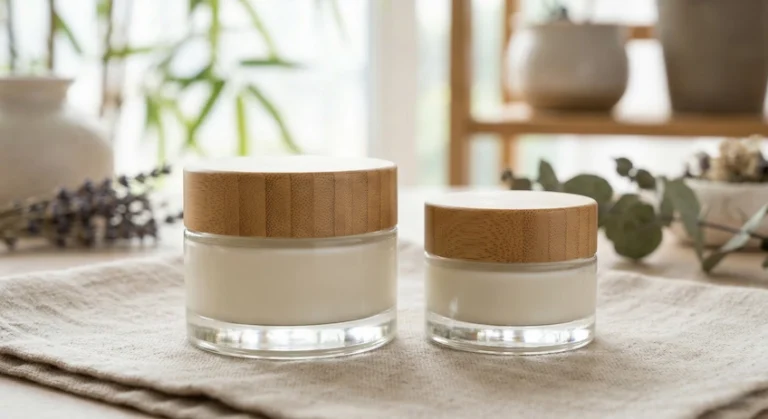

In the era of "Zero Waste," the question isn't just if a jar can be recycled, but how easily it can be recycled.
For cosmetic brands, the challenge is that most luxury packaging is a nightmare for recycling facilities. Glued liners, mixed plastics, and metallized coatings often send "recyclable" jars straight to the landfill.
So, can cosmetic jars, including all components, be fully recycled?
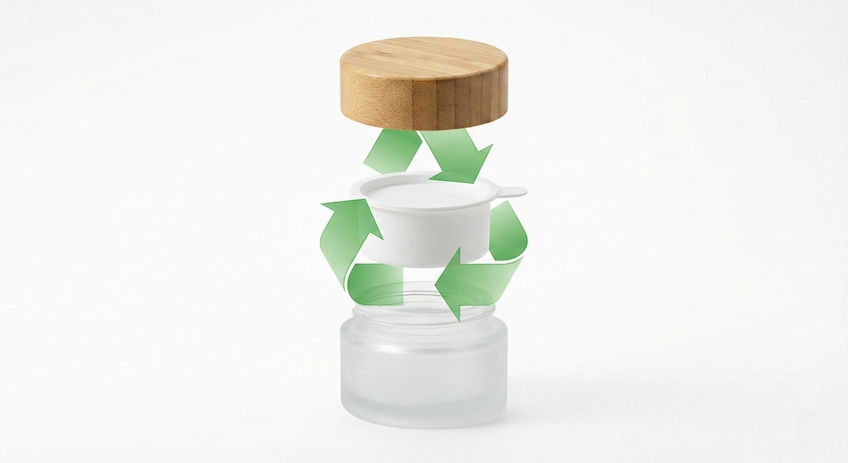
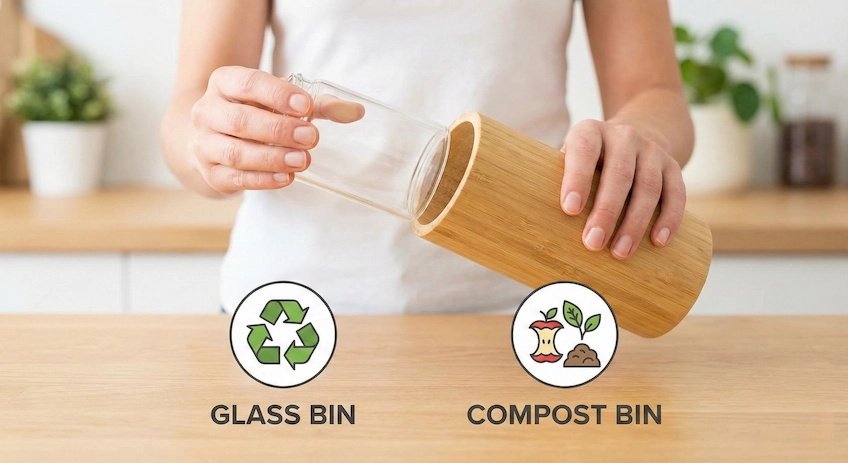
The answer is Yes—but only if designed for disassembly. At ECO-BAMBOO, we engineer our Bamboo Hybrid Jars1 with a modular structure that allows consumers to separate the biodegradable bamboo shell from the recyclable glass or aluminum inner tank in seconds.
1. The "Mixed Material" Problem
Most cosmetic jars fail the recycling test because they are fused together.
- The Issue: A glass jar glued inside a bamboo shell cannot be processed by glass recyclers (contamination) or industrial composters (glass shards).
- The Solution: Friction-Fit Assembly. Our jars use precise engineering to hold components together without permanent adhesives, allowing for 100% separation at the end of life.
2. Component-by-Component Recycling Guide
To claim "100% Recyclable," every part must have a destination. Here is how our modular system works:
| Component | Material | Recycling Destination |
|---|---|---|
| Outer Shell | FSC Bamboo | Industrial Compost or Biodegradable (Garden) |
| Inner Tank | Frosted Glass1 | Glass Recycling Bin (Infinitely recyclable) |
| Inner Tank (Alt) | Aluminum2 | Metal Recycling Bin (High value) |
| Lid Liner | PP / PE Disc | Plastic Recycling (#5) or Trash (Size dependent) |
B2B Insight: By choosing our Bamboo Aluminum Jar2, you can offer a completely Plastic-Free option where the metal inner is highly sought after by recyclers.
3. Designing for the "Circular Economy"
According to the Ellen MacArthur Foundation3, 95% of plastic packaging value is lost after a single use. Brands that switch to Refillable Systems stop this waste loop.
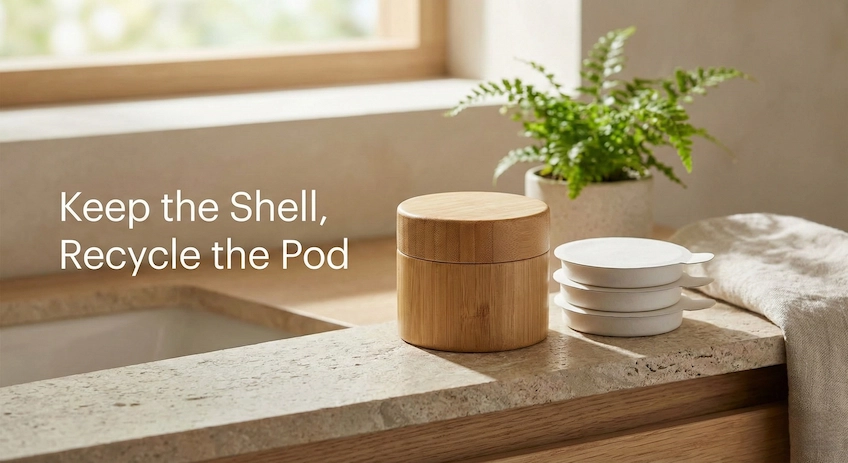
- Refill Model: The customer keeps the expensive bamboo shell and only buys a lightweight refill pod.
- Brand Benefit: Increases customer retention (loyalty loop) and reduces shipping weight.
4. What Cannot Be Recycled? (The "Wish-cycling" Trap)
Honesty builds trust. Avoid "Greenwashing" by educating your customers on what not to recycle:
- Pumps & Sprayers: Contain metal springs inside plastic. Must be trashed or sent to specialized programs (like TerraCycle).
- Black Plastic: Often undetectable by sorting facility scanners.
- Mirrored Coatings: Metallized plastic is non-recyclable.
At ECO-BAMBOO, we focus on Mono-Materials and Natural Finishes to ensure high recovery rates.
Conclusion
Can cosmetic jars be fully recycled? Only if you choose the right supplier. Stop using fused, mixed-material packaging that ends up in the ocean.
Switch to ECO-BAMBOO's Modular Design—where sustainability is built into the blueprint, not just the marketing.
♻️ Close the Loop
Start your sustainable journey today. Request a sample of our fully separable, recyclable jars. 👉 Get Your Recyclable Sample Kit