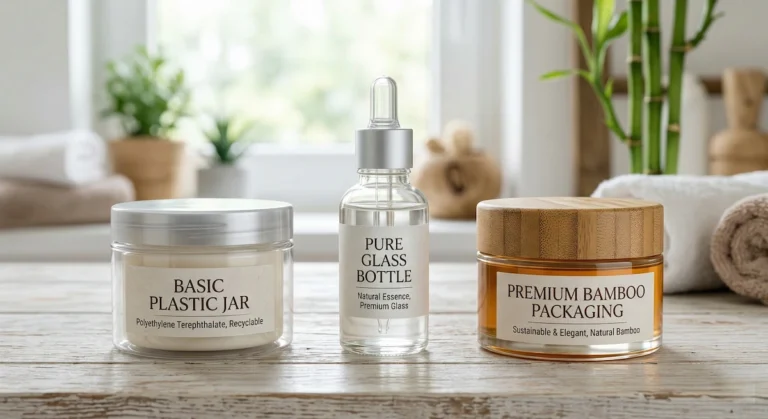

In the race to "Net Zero," packaging is the first hurdle. For skincare brands, the lotion bottle is not just a vessel; it is a statement of values. Consumers are demanding transparency, and retailers are demanding compliance.
But with so many "eco-friendly" options—from bioplastics to glass—which material truly minimizes environmental impact while maintaining product integrity?
At ECO-BAMBOO, we help brands navigate the complex landscape of sustainable packaging. Here is the definitive guide to the most eco-friendly materials for lotion bottles in 2026.
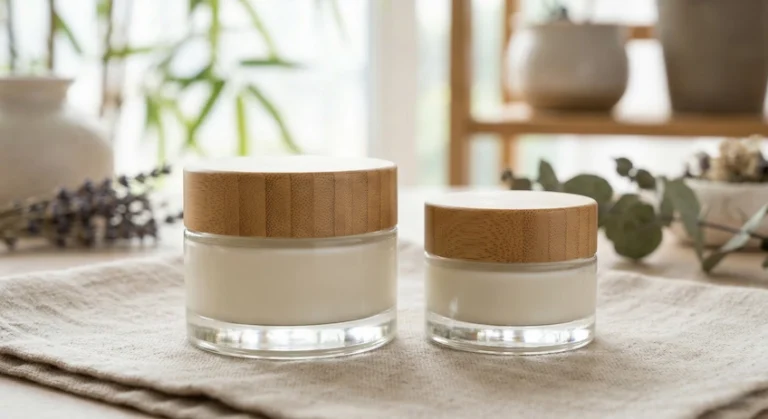
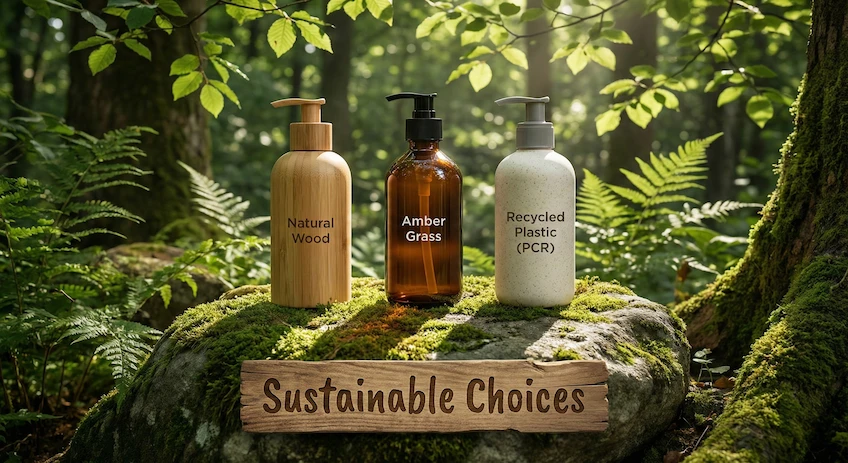
1. Bamboo: The Renewable Champion
Bamboo is the fastest-growing plant on Earth, capable of regenerating in 3-5 years without pesticides. It acts as a carbon sink, absorbing more CO2 than timber.
- The Design Strategy: We use FSC-certified bamboo as a Structural Shell over a minimal inner liner. This reduces plastic usage by up to 70% compared to solid plastic bottles.
- Best For: Brands seeking a natural, organic aesthetic that communicates "green" instantly.
- Our Solution: Wholesale Bamboo Lotion Bottles1 combine the durability of a thin PET inner with the beauty of a bamboo outer.
2. Glass: The Infinitely Recyclable Standard
Glass is the only material that can be recycled endlessly without loss of quality, making it a favorite of the Ellen MacArthur Foundation's Circular Economy2 principles.
- Why It Wins: It is chemically inert (no leaching) and inherently premium.
- The "Bamboo Upgrade": While glass is heavy, our Bamboo-Clad Glass Bottles3 offer shock protection and UV shielding, making them more durable and practical for shipping than naked glass.
- Best For: High-end serums and active formulations where chemical stability is paramount.
3. PCR (Post-Consumer Recycled) Plastic: Closing the Loop
If you must use plastic, make it PCR. It gives a second life to existing waste, reducing the need for virgin fossil fuels.
- The Challenge: Aesthetics. PCR can sometimes look grey, speckled, or cloudy.
- Our Solution: We hide the "imperfect" PCR inner bottle inside a Pristine Bamboo Shell, giving you the best of both worlds: recycled content inside, luxury finish outside.
- Product Link: Bamboo Airless Bottles (PCR Option)4.
4. Refillable Systems: The Zero-Waste Future
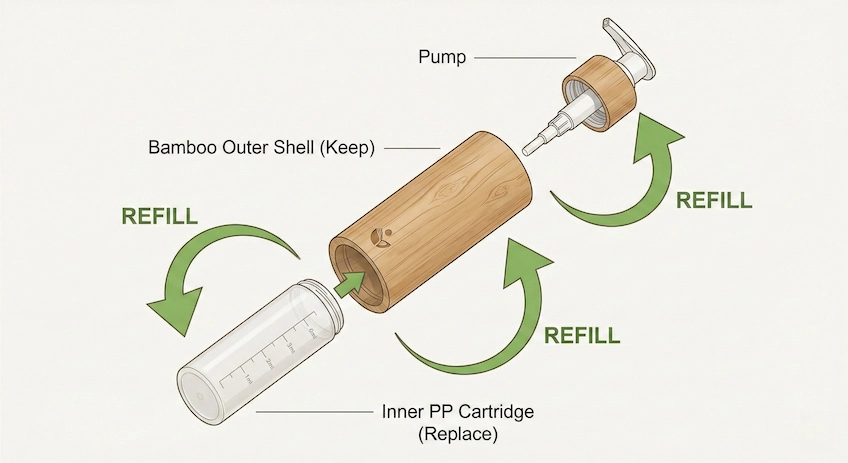
The most sustainable bottle is the one you don't throw away. Refillable Packaging allows the customer to keep the heavy, expensive outer shell (Bamboo/Glass) and only replace the lightweight inner cartridge.
- Impact: Reduces packaging waste by over 80% over the product's life.
- Brand Loyalty: Creates a "lock-in" effect where customers return for refills.
5. Comparison Matrix: Choosing Your Material
Which material aligns with your brand's sustainability goals?
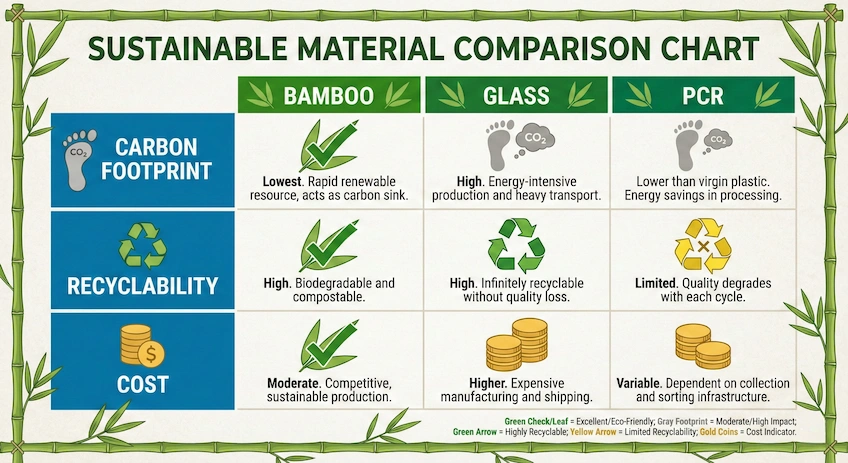
| Material | Renewability | Recyclability | Carbon Footprint | Cost | Best For |
|---|---|---|---|---|---|
| Bamboo Hybrid | High (Fast Growth) | High (Separable) | Lowest | Medium | Organic/Natural Brands |
| Glass | Low (Sand) | Infinite | High (Transport) | Medium | Premium Serums |
| PCR Plastic | N/A (Recycled) | Medium (Downcycled) | Low | Low | Mass Market |
| Aluminum | Low (Mining) | High | Medium | High | Balms/Creams |
Conclusion
There is no single "perfect" material, but there is a Perfect Strategy. For most eco-conscious brands, Bamboo Hybrid Packaging offers the optimal balance: it dramatically reduces plastic, utilizes renewable resources, and protects the formula with a safe inner liner.
Choose ECO-BAMBOO to create packaging that looks as good as it feels to the planet.
🌿 Start Your Sustainable Journey
Ready to switch? Request a sample kit including Bamboo, Glass, and PCR options to see the difference. 👉 Get Your Eco-Friendly Sample Kit