

In the cosmetics industry, a single defective bottle can ruin a customer's experience and tarnish a brand's reputation. For B2B buyers, understanding Manufacturing Defects is the first line of defense against costly recalls.
Whether it's a Functional Failure (leaking pump) or a Cosmetic Flaw (scratch on glass), knowing what to look for during inspections is critical. At ECO-BAMBOO, we implement a Zero-Tolerance Quality Control Policy. Here is your guide to identifying and preventing common defects in lotion packaging.
1. Plastic Bottle Defects: The "Mold & Material" Issues
Plastic bottles (PET/PP) are prone to issues during the injection and blow molding process.
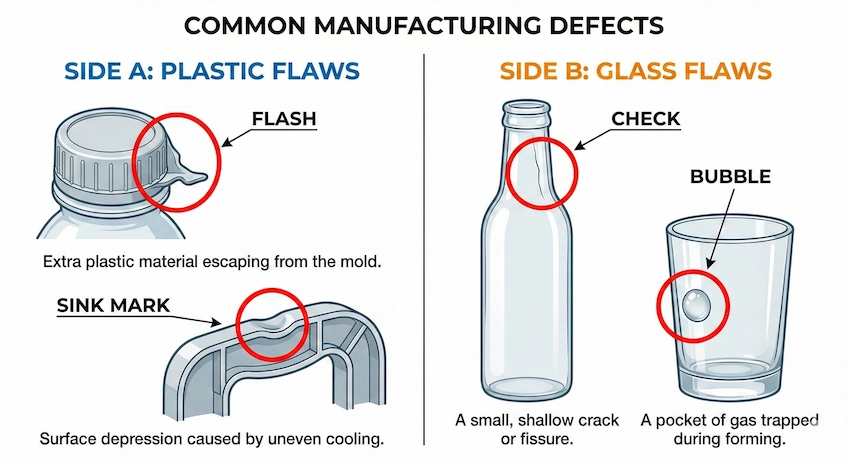
- Short Shots: Incomplete filling of the mold, resulting in missing parts (usually at the neck or base).
- Cause: Insufficient plastic injection pressure.
- Impact: Critical. Bottle leaks or cap won't fit.
- Flash: Excess plastic protruding from the parting line.
- Cause: Mold wear or excessive pressure.
- Impact: Major. Sharp edges can injure users; poor aesthetics.
- Sink Marks: Depressions on the surface.
- Cause: Uneven cooling of thick sections.
- Impact: Minor/Major. Visual flaw; affects "premium" look.
- Our Solution: We use High-Precision Molds1 and automated optical inspection to detect these issues instantly.
2. Glass Bottle Defects: The "Heat & Stress" Issues
Glass production involves extreme heat, leading to specific structural flaws.
- Checks (Cracks): Small hairline fractures, often near the neck or bottom.
- Cause: Thermal shock (cooling too fast).
- Impact: Critical. Risk of breakage and injury.
- Bubbles (Seeds/Blisters): Air trapped inside the glass wall.
- Cause: Impurities in raw material or improper melting.
- Impact: Minor/Major. Large bubbles weaken the structure; small ones look cheap.
- Uneven Wall Thickness: One side is thin, the other thick.
- Cause: Uneven gob distribution.
- Impact: Major. The thin side shatters easily under pressure.
- Our Solution: All our Glass Lotion Bottles2 undergo 100% Light Inspection and pressure testing to ensure uniformity.
3. The "Silent Killer": Functional Defects in Pumps
The bottle might be perfect, but if the pump fails, the product fails.
- Priming Failure: Pump takes >10 strokes to dispense.
- Leakage: Product seeps from the collar during transport.
- Stuck Actuator: Pump head doesn't pop up or return.
- Prevention: We perform Vacuum Leak Tests3 on random samples from every batch to ensure seal integrity in our Airless and Standard pumps.
4. Defect Classification Table: AQL Standards
Use this table to set your Acceptable Quality Limit (AQL) with suppliers.
| Defect Type | Definition | Example | Recommended AQL |
|---|---|---|---|
| Critical | Hazardous or Unsafe | Broken glass, sharp flash, leaking | 0% (Zero Tolerance) |
| Major | Functional Failure | Pump won't work, stripped thread | 1.0% |
| Minor | Aesthetic Flaw | Scratches, color variation, dirt | 2.5% - 4.0% |
Conclusion
Quality Control is not an "add-on"; it is the foundation of your brand. By understanding these common defects—Short Shots, Flash, Checks, and Bubbles—you can hold your suppliers accountable.
At ECO-BAMBOO, we don't just sell bottles; we deliver Certified Quality.
🔍 Secure Your Supply Chain
Tired of inconsistent quality? Request a sample kit of our QC-passed Bamboo and Glass bottles to feel the difference. 👉 Get Your Quality-Assured Sample Kit