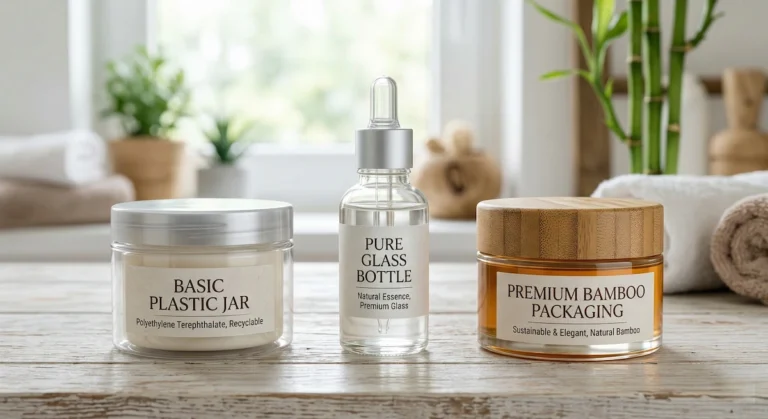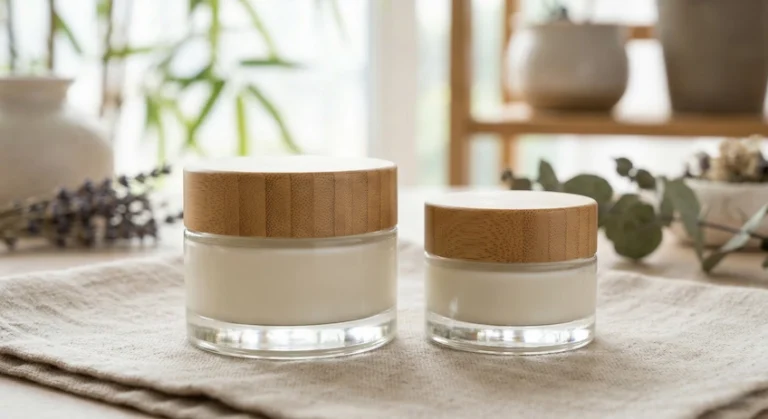

In the beauty industry, the "end-of-life" plan for packaging is just as critical as the design itself. [cite_start]Consumers are asking: "Can this jar be recycled?" Brands that cannot answer "Yes" risk losing market share[cite: 1, 2].
While materials like bamboo, glass, and aluminum are inherently recyclable, the real challenge lies in mixed-material construction. A glass jar glued permanently into a bamboo shell is a recycling nightmare.
At ECO-BAMBOO, we engineer Separable Bamboo Jars1 designed for the circular economy. This guide explains how to ensure your packaging is truly recyclable and reuse-friendly.
1. The Recycling Reality: "Mono-Material" vs. "Mixed"
[cite_start]Most "beauty empties" end up in landfills because they are composite structures that cannot be separated[cite: 6, 23]. To be recyclable, a package must be easily disassembled into single-material components.
Recyclability by Material Type
| Material | Recyclability | Action Required |
|---|---|---|
| Glass | High (Infinite) | [cite_start]Rinse & Place in Glass Bin [cite: 12, 13] |
| Aluminum | High (High Value) | [cite_start]Rinse & Place in Metal Bin [cite: 16, 17] |
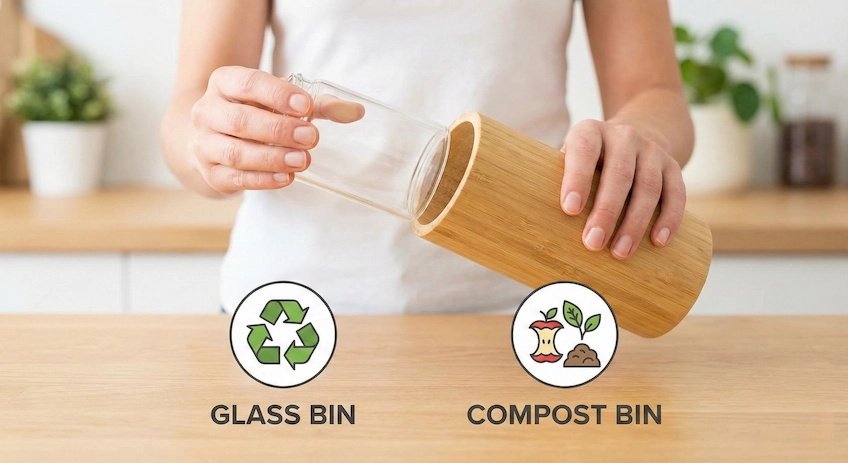
| Bamboo | High (Biodegradable) | [cite_start]Remove & Compost [cite: 18, 19] |
| Mixed Plastics | Low (Difficult) | [cite_start]Often Non-Recyclable (Pumps/Laminates) [cite: 31, 37] |
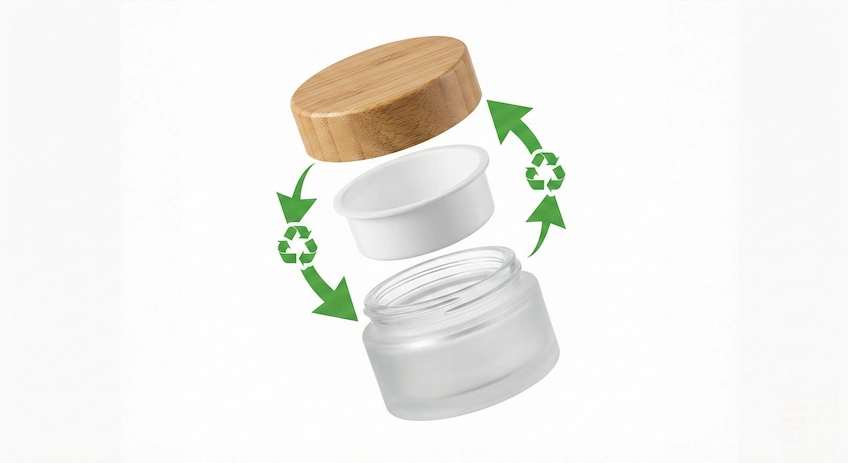
B2B Solution: Our Bamboo Aluminum Jars2 feature a friction-fit design. The user can pop out the aluminum inner for recycling and compost the bamboo shell—zero glue, zero waste.
2. Reuse Strategies: The "Refill Revolution"
Recycling is good; reusing is better. Sturdy packaging like Thick-Walled Glass Jars3 is ideal for reuse.
How Brands Can Promote Reuse:
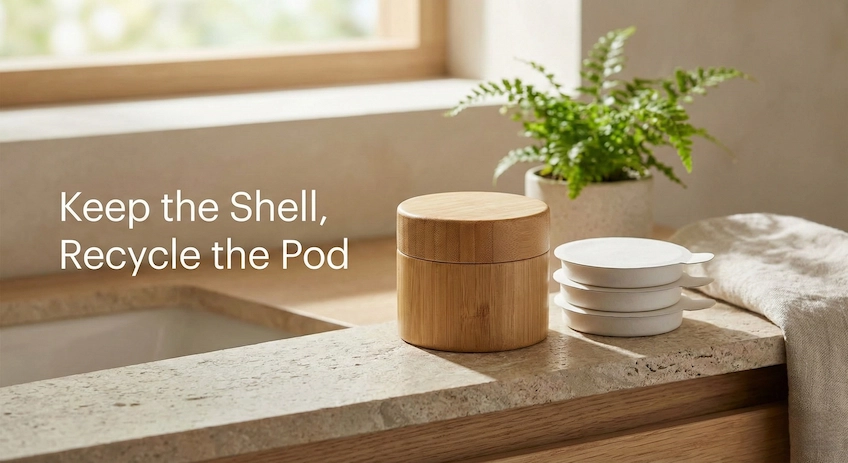
- [cite_start]Refill Systems: Offer lightweight refill pods that fit into the premium bamboo outer shell[cite: 40].
- [cite_start]Upcycling Campaigns: Encourage customers to clean jars for travel storage, DIY blends, or jewelry holders[cite: 39, 44, 46].
- Durability: Ensure the jar survives the dishwasher/sterilization process without the logo fading.
3. What Cannot Be Recycled? (Avoid These Design Flaws)
To build a sustainable brand, you must avoid "Wish-cycling"—designing packaging that looks eco-friendly but isn't.
- [cite_start]Multi-Layer Laminates: Flexible pouches often used for samples are non-recyclable[cite: 23, 31].
- Pumps & Droppers: Contain metal springs inside plastic housing. [cite_start]Hard to separate[cite: 31, 37].
- [cite_start]Mirrored/Frosted Glass: Some treatments make glass unrecyclable in standard facilities[cite: 31].
The Fix: Use Mono-Material Closures4 or implement a "Take-Back Program" for complex parts.
4. Proper Disposal Instructions for Your Customers
[cite_start]Educating your user is part of the product experience[cite: 9]. Print clear icons on your box:
- [cite_start]Rinse: "Wash out all residue to prevent contamination." [cite: 3, 20, 26]
- [cite_start]Separate: "Pop the inner jar out of the bamboo shell." [cite: 3, 6, 20]
- [cite_start]Sort: "Glass in the bin; Bamboo in the compost." [cite: 7, 23, 30]
Conclusion
Can cosmetic jars be reused or recycled? Yes—but only if you design them that way. Shift from glued, mixed materials to Modular Design.
Choose ECO-BAMBOO for packaging that respects the planet and delights the conscious consumer.
♻️ Design for the Future
Ready to switch to fully recyclable packaging? Request a sample of our separable bamboo jars. 👉 Get Your Sustainable Sample Kit